
Cleaning your dryer vent is one of the most important maintenance tasks you can perform to help keep your dryer operating efficiently. A clean vent allows warm, moist air to escape properly, helps clothes dry faster, reduces unnecessary wear on the appliance, and minimizes lint accumulation inside the exhaust system.
Because of these benefits, millions of homeowners search online each year for DIY dryer vent cleaning solutions. Home improvement stores sell inexpensive brush kits, flexible rods, vacuum attachments, and other tools that promise quick and easy results. Online videos often suggest that cleaning a dryer vent is a simple weekend project that anyone can complete in less than an hour.
While routine DIY maintenance can certainly be beneficial, DIY dryer vent cleaning may not be the best solution for every home or every dryer vent system.
Many dryer vent systems are longer and more complex than they appear. Hidden elbows inside walls, long horizontal duct runs, vertical risers, rooftop terminations, and tightly installed laundry appliances can make it difficult to inspect and clean the entire system using basic household tools. As a result, homeowners may remove visible lint while leaving behind significant accumulations deeper within the ductwork.
This doesn’t mean you should avoid maintaining your dryer vent. In fact, homeowners play an important role in keeping their dryers operating safely and efficiently. Cleaning the lint screen after every load, checking the outside vent hood, and performing routine visual inspections are all excellent maintenance habits. However, understanding the limitations of DIY cleaning is just as important as knowing its benefits.
In this comprehensive guide, we’ll explain what homeowners can realistically accomplish with DIY dryer vent cleaning, discuss common mistakes, explore the limitations of consumer cleaning kits, and help you recognize situations where additional cleaning or inspection may be beneficial. Whether you own a single-family home, condominium, apartment, or manage a commercial laundry facility, this guide will help you make informed decisions about maintaining your dryer vent system.
Why Homeowners Choose DIY Dryer Vent Cleaning
It’s easy to understand why DIY dryer vent cleaning has become so popular. Consumer cleaning kits are widely available, online tutorials make the process appear straightforward, and many homeowners enjoy completing maintenance projects themselves. In many cases, routine DIY maintenance can contribute to better dryer performance when performed carefully and regularly.
Some of the most common reasons homeowners choose to clean their own dryer vents include:
Saving Money
One of the biggest motivations is reducing maintenance costs. Purchasing a dryer vent brush kit is typically much less expensive than hiring a professional service, making DIY cleaning an attractive option for homeowners looking to handle routine maintenance themselves.
Convenience
DIY cleaning can often be performed whenever it fits a homeowner’s schedule. There is no need to make an appointment or wait for a technician, making it a convenient option for people who prefer handling home maintenance on their own.
Easy Access to Tools
Many home improvement retailers and online stores offer affordable dryer vent cleaning kits. These typically include flexible rods, rotary brushes, vacuum attachments, and adapters designed to reach inside the ductwork. The availability of these tools encourages many homeowners to attempt the job themselves.
Online Tutorials
Video-sharing platforms and home improvement websites feature thousands of tutorials demonstrating dryer vent cleaning techniques. While these resources can provide helpful maintenance tips, every dryer vent system is different. A method that works well for one home may not be effective or appropriate for another.
Routine Home Maintenance
Many homeowners simply enjoy maintaining their homes. Regular inspections, cleaning, and preventative maintenance can extend the life of household appliances and help identify potential issues before they become more significant.
These are all reasonable motivations, and for straightforward installations, homeowners may successfully remove lint from accessible portions of the vent system. However, it’s important to understand that accessibility is one of the biggest factors determining how effective DIY dryer vent cleaning will be.
A short, straight vent with easy access behind the dryer is very different from a multi-story home with a long duct run, several elbows, or a rooftop exhaust. In those situations, consumer tools may have difficulty reaching every section of the system, leaving lint buildup in areas that cannot be easily inspected.
What DIY Dryer Vent Cleaning Can Accomplish
A common misconception is that DIY dryer vent cleaning is either completely effective or not worthwhile at all. In reality, the answer lies somewhere in between. When performed correctly, routine DIY maintenance can be a valuable part of caring for your dryer. Understanding what homeowners can realistically accomplish helps set appropriate expectations.
Cleaning the Lint Filter
The lint filter should be cleaned after every load of laundry. Although this simple task only takes a few seconds, it plays an important role in maintaining airflow through the dryer. A clogged lint screen restricts airflow, increases drying time, and places additional strain on the appliance.
Periodically washing the lint screen with warm water and a mild detergent can also help remove residue left behind by fabric softeners and dryer sheets, allowing air to pass through more freely.
Vacuuming Around the Dryer
Lint often accumulates around and underneath the dryer. Carefully vacuuming these areas helps reduce dust, improves cleanliness, and prevents loose lint from being drawn into the appliance or laundry room.
Inspecting the Exterior Vent Hood
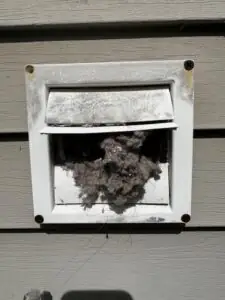
Checking the outside vent hood is another task homeowners can easily perform. The vent flap should open fully while the dryer is operating and close securely when the dryer is off. Restricted movement, visible lint buildup, or obstructions such as leaves, insects, or bird nesting material may indicate that additional cleaning is needed.
Cleaning Accessible Sections of the Vent
If the transition duct behind the dryer is easy to reach and disconnect safely, homeowners may be able to remove visible lint from this section using appropriate tools. In some installations, a short, straight duct can also be cleaned with a consumer brush kit.
However, accessibility varies greatly from one home to another. Some dryers are installed in spacious laundry rooms with ample working space, while others are tucked into closets, alcoves, or utility rooms where reaching the vent connection is difficult without moving the appliance.
Performing Routine Visual Inspections
Homeowners can also look for warning signs that suggest a dryer vent may require additional attention. Longer drying times, excessive heat, unusual odors, weak airflow at the exterior vent, or visible lint around the appliance are all indicators that further inspection may be beneficial.
Routine DIY maintenance provides an excellent first line of defense against lint buildup. Nevertheless, it’s important to recognize that removing lint from accessible areas does not necessarily mean the entire vent system has been thoroughly cleaned. In the next section, we’ll examine why many dryer vent systems present challenges that make DIY cleaning less effective than homeowners often expect.
What DIY Dryer Vent Cleaning Can Accomplish
A common misconception is that DIY dryer vent cleaning is either completely effective or not worthwhile at all. In reality, the answer lies somewhere in between. When performed correctly, routine DIY maintenance can be a valuable part of caring for your dryer. Understanding what homeowners can realistically accomplish helps set appropriate expectations.
Cleaning the Lint Filter
The lint filter should be cleaned after every load of laundry. Although this simple task only takes a few seconds, it plays an important role in maintaining airflow through the dryer. A clogged lint screen restricts airflow, increases drying time, and places additional strain on the appliance.
Periodically washing the lint screen with warm water and a mild detergent can also help remove residue left behind by fabric softeners and dryer sheets, allowing air to pass through more freely.
Vacuuming Around the Dryer
Lint often accumulates around and underneath the dryer. Carefully vacuuming these areas helps reduce dust, improves cleanliness, and prevents loose lint from being drawn into the appliance or laundry room.
Inspecting the Exterior Vent Hood
Checking the outside vent hood is another task homeowners can easily perform. The vent flap should open fully while the dryer is operating and close securely when the dryer is off. Restricted movement, visible lint buildup, or obstructions such as leaves, insects, or bird nesting material may indicate that additional cleaning is needed.
Cleaning Accessible Sections of the Vent
If the transition duct behind the dryer is easy to reach and disconnect safely, homeowners may be able to remove visible lint from this section using appropriate tools. In some installations, a short, straight duct can also be cleaned with a consumer brush kit.
However, accessibility varies greatly from one home to another. Some dryers are installed in spacious laundry rooms with ample working space, while others are tucked into closets, alcoves, or utility rooms where reaching the vent connection is difficult without moving the appliance.
Performing Routine Visual Inspections
Homeowners can also look for warning signs that suggest a dryer vent may require additional attention. Longer drying times, excessive heat, unusual odors, weak airflow at the exterior vent, or visible lint around the appliance are all indicators that further inspection may be beneficial.
Routine DIY maintenance provides an excellent first line of defense against lint buildup. Nevertheless, it’s important to recognize that removing lint from accessible areas does not necessarily mean the entire vent system has been thoroughly cleaned. In the next section, we’ll examine why many dryer vent systems present challenges that make DIY cleaning less effective than homeowners often expect.
Why DIY Dryer Vent Cleaning May Not Be Best
There is no question that DIY dryer vent cleaning has its place in regular home maintenance. Cleaning the lint screen after every load, vacuuming around the dryer, and occasionally removing lint from easily accessible sections of the vent are all worthwhile tasks.
However, many homeowners are surprised to learn that cleaning the visible portions of a dryer vent system is often only a small part of the job.
The reason is simple: most dryer vent systems are hidden behind walls, above ceilings, inside floor joists, or routed through attics and crawl spaces. What you can see from inside the laundry room may represent only a fraction of the total exhaust duct.
As dryers have become more efficient and homes have become larger, dryer vent systems have also become more complex. It is common to find vent systems that include:
- Long horizontal duct runs
- Multiple 90-degree elbows
- Vertical risers
- Roof exhaust terminations
- Wall cavities
- Concealed transition ducts
- Shared risers in condominiums
- Long commercial exhaust systems
Every bend in the duct creates an area where lint can slow down and begin accumulating. Even if a homeowner removes a significant amount of lint using a brush kit, additional deposits may remain in places that cannot be easily reached or inspected.
This doesn’t mean DIY cleaning is ineffective. Rather, it means that the effectiveness of DIY cleaning depends heavily on the design and accessibility of the dryer vent system.
A short, straight vent with easy access behind the dryer may be relatively simple to maintain. A longer or concealed system often presents different challenges.
Real-World Example: Why Accessibility Matters
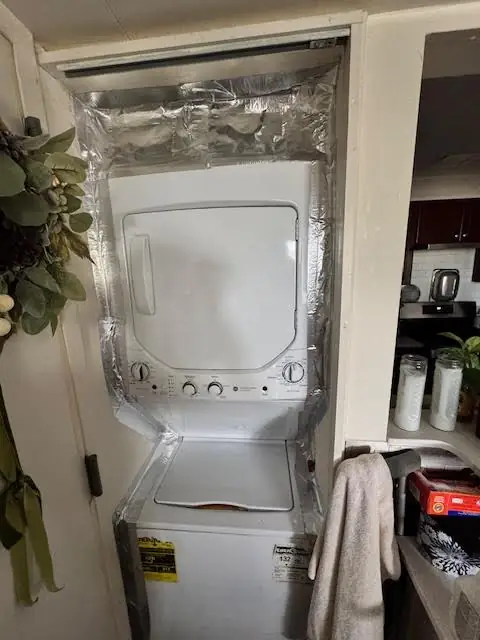
One of the most common misconceptions is that every dryer vent can be cleaned from the front of the appliance.
In reality, this is rarely the case.
The installation shown above is a good example. The stacked washer and dryer are positioned inside a confined laundry closet with very limited clearance on each side. Although the lint screen is easy to access, the actual dryer vent connection is hidden behind the appliance.
To inspect or clean this section thoroughly, several steps may be necessary:
- Disconnect the electrical power or gas supply, when applicable.
- Carefully move the dryer without damaging the floor or surrounding cabinetry.
- Disconnect the transition duct.
- Inspect the vent connection.
- Check for crushed, kinked, or disconnected ductwork.
- Remove accumulated lint before reconnecting and testing the system.
Moving large appliances is not always simple. Some stacked units are secured in place, while others weigh several hundred pounds and require two people to move safely. In condominiums and apartments, limited space can make access even more difficult.
This is one reason homeowners often clean only the portions of the vent system that are visible, leaving hidden sections untouched.
Hidden Areas Most Homeowners Cannot Reach
When homeowners think about dryer vent cleaning, they often picture a single straight pipe leading from the dryer to the outside wall.
In practice, dryer vent systems are rarely that simple.
During inspections, technicians commonly find lint accumulation in areas that are completely hidden from view.
Behind the Dryer
The transition duct connecting the dryer to the wall is one of the most common locations for lint buildup.
If the flexible duct becomes crushed while pushing the dryer back into place, airflow can be significantly reduced.
Inside the First Elbow
Whenever airflow changes direction, lint tends to settle.
The first 90-degree elbow immediately behind the dryer frequently contains compacted lint that is difficult to remove with inexpensive brush kits.
Long Horizontal Runs
Many homes require the dryer vent to travel 20, 30, or even 40 feet before reaching the exterior.
As the duct becomes longer, airflow naturally decreases, allowing additional lint to settle throughout the system.
Vertical Dryer Vents
In townhomes, condominiums, and apartment buildings, dryer vents sometimes travel vertically before exiting through the roof.
Gravity works against airflow in these systems, making routine inspection and maintenance even more important.
Roof Terminations
Roof-mounted dryer vents are often overlooked because homeowners cannot easily inspect them.
Over time, lint, leaves, nesting material, or weather-related debris may restrict airflow at the termination point.
Exterior Vent Hood
Many homeowners clean the inside of the vent but forget to inspect the exterior hood.
The flap should open fully whenever the dryer operates.
If it barely opens, remains partially closed, or appears obstructed by lint, additional cleaning or inspection may be needed.
Shared Laundry Systems
In apartment buildings and condominiums, multiple dryers may connect to a common vertical exhaust riser.
These systems require specialized maintenance procedures because lint from multiple units can accumulate within the shared ductwork.
Individual homeowners generally cannot inspect or clean these common systems themselves.
The Limitations of Dryer Vent Cleaning Kits
Walk into almost any home improvement store and you’ll find a variety of dryer vent cleaning products.
Common examples include:
- Flexible brush kits
- Drill-powered rotary brushes
- Vacuum attachments
- Flexible extension rods
- Leaf blower adapters
- Air-powered cleaning tools
These products can be useful for routine maintenance, particularly when the vent system is short, straight, and easily accessible.
However, they also have limitations that homeowners should understand.
They Cannot Show You What’s Inside
Perhaps the biggest limitation is visibility.
Most consumer cleaning kits remove lint without allowing the homeowner to actually inspect the inside of the duct.
Without seeing the vent interior, it’s difficult to know:
- Whether lint remains inside.
- If the duct has become disconnected.
- Whether an elbow is completely blocked.
- If birds or rodents have entered the vent.
- Whether moisture has damaged the duct.
- If the vent was installed correctly.
Removing some lint does not necessarily mean the vent is completely clean.
Brushes Follow the Path of Least Resistance
Rotary brushes are designed to follow the inside of the duct.
When they encounter sharp elbows or tight turns, they may:
- Skip portions of the elbow.
- Compress lint into corners.
- Lose contact with the duct wall.
- Become difficult to retrieve.
This is especially true in older homes where ductwork may include several bends.
Household Vacuums Have Limited Suction
Most household vacuums are designed to collect dust and debris from floors not to pull lint through long metal ducts.
Although they may remove loose lint near the dryer connection, they typically cannot maintain sufficient suction through long vent systems.
Consumer Tools Cannot Measure Airflow
After cleaning, many homeowners simply assume the vent is clean because lint came out.
In reality, airflow is often a better indicator of system performance than the amount of lint removed.
Professional technicians may use airflow testing and system inspections to help determine whether restrictions remain after cleaning.
Every Home Is Different
Perhaps the most important point is that there is no single cleaning method that works for every dryer vent system.
A single-story ranch home with a short exterior wall vent requires a different approach than a condominium with a rooftop termination or a commercial laundry room with shared exhaust ducts.
Understanding these differences helps homeowners choose the maintenance approach that best fits their specific installation.
Can a Leaf Blower Clean a Dryer Vent?
One of the most common questions homeowners ask is whether a leaf blower can be used to clean a dryer vent. A quick online search reveals countless videos showing large clouds of lint blowing out of exterior vents, making the method appear fast and effective.
The reality is more nuanced.
A leaf blower may remove some loose lint from certain dryer vent systems, but it is not a one-size-fits-all solution. Its effectiveness depends on factors such as the length of the vent, the number of bends, the type of ductwork, and the condition of the lint inside.
Situations Where a Leaf Blower May Help
A leaf blower may be useful when:
- The vent run is short and relatively straight.
- The duct is constructed of smooth metal.
- Lint buildup is light and dry.
- The duct has already been mechanically cleaned.
- There are no sharp bends or restrictions.
Even in these situations, a leaf blower primarily moves loose lint it does not inspect the vent or verify that the entire system is clean.
Limitations of Using a Leaf Blower
There are also important limitations:
- Compacted lint may remain in elbows and low spots.
- Heavy lint deposits often cannot be dislodged by airflow alone.
- A disconnected or damaged duct may not be obvious.
- Lint may be blown deeper into certain sections instead of being completely removed.
- Exterior vent hoods with screens or restricted openings may prevent lint from exiting efficiently.
Without inspecting the interior of the duct, homeowners have no reliable way to confirm that the vent is fully clear.
Bottom line: A leaf blower can sometimes assist with maintenance, but it should not be considered a complete inspection or cleaning method for every dryer vent system.
Common Mistakes During DIY Dryer Vent Cleaning
Many homeowners approach dryer vent cleaning with good intentions. However, several common mistakes can reduce the effectiveness of the cleaning—or even create new problems.
Understanding these mistakes can help you perform routine maintenance more safely and effectively.
Cleaning Only the Lint Screen
Cleaning the lint filter after every load is one of the best habits you can develop.
However, the lint screen captures only part of the lint produced during drying. Fine fibers continue through the exhaust system and gradually accumulate inside the ductwork.
A clean lint screen does not necessarily mean the dryer vent is clean.
Assuming the Vent Is Clean Because Lint Came Out
Many homeowners remove a handful of lint with a brush kit and assume the job is complete.
Unfortunately, visible lint represents only what was accessible.
Additional lint may remain:
- behind elbows
- inside long horizontal runs
- near roof terminations
- behind the dryer
- inside concealed wall cavities
Removing some lint is encouraging, but it doesn’t confirm the entire vent system has been cleaned.
Forgetting to Inspect the Exterior Vent Hood
The exterior vent hood provides valuable information about dryer performance.
When the dryer is running:
- the flap should open fully,
- warm, moist air should be felt exiting the vent,
- airflow should be steady and unrestricted.
A flap that barely opens or opens only slightly may indicate a restriction somewhere in the system.
Damaging the Transition Duct
One of the easiest mistakes to make occurs after cleaning.
While pushing the dryer back into position, homeowners sometimes crush or kink the flexible transition duct.
Even a partially flattened duct can significantly reduce airflow and decrease dryer efficiency.
After reconnecting the dryer, always confirm that the duct has not become compressed.
Ignoring Manufacturer Recommendations
Most dryer manufacturers recommend using rigid or semi-rigid metal transition ducts whenever possible.
Plastic or thin vinyl ducts can sag, collect lint more easily, and may not perform as well as smooth metal ducts.
Always follow the appliance manufacturer’s installation instructions and applicable local building codes.
Failing to Check Dryer Performance After Cleaning
Cleaning should improve airflow.
After maintenance, pay attention to:
- drying time,
- dryer temperature,
- airflow at the outside vent,
- unusual noises,
- burning odors.
If performance has not improved, additional inspection may be appropriate.
Warning Signs Your Dryer Vent Still Needs Cleaning
Many homeowners wonder how they can tell whether their dryer vent remains partially clogged after performing DIY maintenance.
Fortunately, the dryer often provides several warning signs.
Clothes Take Longer to Dry
If clothing that once dried in a single cycle now requires two or three cycles, restricted airflow may be preventing moist air from leaving the dryer efficiently.
Longer drying times also increase energy consumption and place additional wear on the appliance.
The Dryer Feels Excessively Hot
Warm exterior surfaces are normal during operation.
However, if the top or sides of the dryer become unusually hot, the appliance may be working harder than intended because heated air cannot escape properly.
The Laundry Room Feels Hot or Humid
A properly functioning dryer vent should exhaust warm, moist air outside the home.
If the laundry room becomes unusually warm or humid during operation, it may indicate restricted airflow or an improperly connected exhaust duct.
A Burning Odor
A burning smell should never be ignored.
Although there can be several causes, accumulated lint exposed to excessive heat is one possible explanation.
If you notice a persistent burning odor, discontinue use of the dryer until the cause has been identified.
Weak Airflow Outside
One of the easiest checks homeowners can perform is observing the airflow at the exterior vent.
While the dryer is operating:
- the vent flap should open completely,
- warm air should be exiting,
- airflow should feel steady.
Weak airflow may suggest that lint or another obstruction is restricting the exhaust system.
Excess Lint Around the Dryer
Finding large amounts of lint behind or beneath the dryer may indicate that the transition duct has become loose, disconnected, or damaged.
This should be addressed promptly to help maintain proper airflow.
The Dryer Stops Before the Cycle Ends
Many modern dryers include sensors that detect excessive temperatures.
Restricted airflow can cause these safety features to activate, resulting in unexpectedly short drying cycles or repeated shutdowns.
Recommended Dryer Vent Maintenance Schedule
Every household uses its dryer differently.
A family of six that washes multiple loads every day places far greater demands on the dryer vent system than someone living alone.
For that reason, maintenance schedules should reflect actual usage rather than relying on a single timetable.
| Household Type | Suggested Inspection | Suggested Cleaning* |
|---|---|---|
| Single occupant | Every 12 months | Every 12–18 months |
| Couple | Every 12 months | Every 12 months |
| Family of 3–5 | Every 6–12 months | Every 6–12 months |
| Large family | Every 6 months | Every 6 months |
| Pet owners | Every 6 months | Every 6–12 months |
| Vacation rental | Before each busy season | Based on usage |
| Apartment building laundry room | Regular inspections | Based on usage and system design |
| Commercial laundry facility | Routine inspections | Maintenance schedule based on manufacturer recommendations and operating conditions |
*Actual cleaning frequency depends on dryer usage, vent length, installation, and observed lint accumulation.
Quick Homeowner Maintenance Checklist
Consider reviewing these items regularly:
✅ Clean the lint filter after every load.
✅ Wash the lint screen occasionally with warm water and mild detergent to remove residue.
✅ Inspect the exterior vent hood monthly.
✅ Keep the area around the dryer free of lint and dust.
✅ Check that the transition duct has not been crushed or kinked.
✅ Pay attention to drying times and airflow.
✅ Investigate unusual odors, overheating, or repeated automatic shutdowns.
How Professional Dryer Vent Cleaning Differs from DIY Cleaning
DIY dryer vent cleaning can be an excellent way to maintain your dryer between more thorough inspections. Cleaning the lint filter, checking the exterior vent hood, and removing lint from accessible areas all contribute to better dryer performance.
Professional dryer vent cleaning, however, is typically more comprehensive. Rather than focusing only on visible lint, technicians evaluate the condition of the entire accessible vent system, looking for restrictions, damaged ductwork, improper installations, and other issues that may affect airflow.
The exact cleaning process varies depending on the installation, but professional services often include:
- Inspection of the accessible vent system.
- Safe disconnection and reconnection of the dryer, when necessary.
- Cleaning of the transition duct.
- Cleaning of long duct runs using specialized equipment.
- Removal of lint from elbows and difficult-to-reach areas.
- Inspection of the exterior vent hood.
- Identification of damaged or improperly installed ductwork.
- Functional testing after cleaning.
Rather than relying on a single tool, technicians typically choose equipment based on the design and condition of the vent system.
DIY Cleaning vs. Professional Dryer Vent Cleaning
| DIY Maintenance | Professional Service |
|---|---|
| Cleans accessible areas | Cleans the entire accessible vent system |
| Consumer-grade tools | Commercial-grade equipment |
| Limited visual inspection | More comprehensive inspection |
| Best for routine maintenance | Suitable for routine maintenance and more complex systems |
| May not identify damaged ducts | Can identify damaged, crushed, or disconnected ducts |
| No specialized airflow testing | May include airflow or performance verification |
Neither approach replaces the other. Routine homeowner maintenance and periodic professional cleaning can complement one another, helping to keep the dryer operating efficiently over time.
Benefits of Professional Dryer Vent Cleaning
Although every home is different, many homeowners notice improvements after a thorough dryer vent cleaning.
Improved Airflow
Removing accumulated lint helps warm, moist air travel through the vent system more efficiently. Better airflow can improve overall dryer performance.
Shorter Drying Times
Restricted airflow often means clothing takes longer to dry. Restoring proper airflow may reduce the number of drying cycles needed for many loads.
Improved Energy Efficiency
When a dryer operates efficiently, it may use less electricity or natural gas because drying cycles are shorter.
Actual energy savings depend on the condition of the vent before cleaning, the type of dryer, and household usage.
Reduced Wear on the Dryer
Long drying cycles place additional demands on heating elements, motors, belts, sensors, and other components.
Improving airflow may reduce unnecessary wear over time.
Better Moisture Removal
Dryers remove moisture by exhausting warm, humid air outdoors.
When airflow is restricted, moisture may remain inside the drum longer, extending drying times and increasing humidity in the laundry room.
Opportunity to Identify Other Problems
During cleaning, technicians sometimes discover issues unrelated to lint, including:
- Crushed transition ducts
- Loose duct connections
- Improper vent materials
- Bird nests
- Insect infestations
- Damaged exterior vent hoods
- Water intrusion
- Improper vent routing
Identifying these conditions early may help prevent larger problems later.
DIY Dryer Vent Cleaning: Myths vs. Facts
Myth:
“If I clean the lint screen, my dryer vent is clean.”
Fact:
The lint screen captures only a portion of the lint produced during drying. Fine fibers continue into the vent system.
Myth:
“My clothes dry, so my vent must be clean.”
Fact:
Many partially restricted vents still allow the dryer to operate, although drying times may gradually increase over time.
Myth:
“All dryer vents are the same.”
Fact:
Vent systems vary considerably depending on the home. Some are only a few feet long, while others travel through attics, crawlspaces, ceilings, or rooftops.
Myth:
“If lint came out, everything must be clean.”
Fact:
Visible lint indicates that some material was removed, but hidden lint may still remain in elbows, long duct runs, or other concealed areas.
Myth:
“Dryer vent cleaning is only necessary when there’s a problem.”
Fact:
Routine inspection and maintenance can help identify developing issues before they affect dryer performance.
Frequently Asked Questions
Can I clean my dryer vent myself?
Yes. Many homeowners can safely perform routine maintenance, such as cleaning the lint screen, inspecting the exterior vent hood, and removing lint from accessible sections of the vent. The effectiveness of DIY cleaning depends on the design and accessibility of the vent system.
How often should I clean my dryer vent?
The appropriate frequency depends on factors such as laundry volume, vent length, pet hair, and household size. Many homes benefit from periodic inspections and routine maintenance.
Is a dryer vent brush enough?
Brush kits can be effective for accessible portions of certain vent systems, but they may not reach every section of longer or more complex installations.
Can a clogged dryer vent increase drying time?
Yes. Restricted airflow is one of the most common reasons clothes require multiple drying cycles.
Can I use a vacuum cleaner?
A household vacuum may help remove lint near the dryer connection but typically has limited effectiveness in long vent systems.
Can a leaf blower clean my dryer vent?
A leaf blower may remove some loose lint from certain installations, but it does not inspect the vent or guarantee that all lint has been removed.
Why is my laundry room so hot?
Excess heat or humidity in the laundry room may indicate restricted airflow or an issue with the dryer vent system.
What type of dryer vent is recommended?
Most manufacturers recommend rigid or semi-rigid metal ducts because they generally provide smoother airflow and collect less lint than flexible plastic or vinyl ducts.
Always follow the appliance manufacturer’s instructions and applicable local building codes.
Should I disconnect the dryer myself?
If the dryer can be safely moved and disconnected according to the manufacturer’s instructions, some homeowners choose to inspect the transition duct. Gas dryers require additional caution, and if you are unsure how to disconnect or reconnect the appliance safely, it is generally best to seek qualified assistance.
How long does professional dryer vent cleaning take?
The time varies depending on the length, accessibility, and condition of the vent system. Straightforward residential jobs may take less time than longer or more complex installations.
Finally
Routine dryer vent maintenance is an important part of homeownership. Cleaning the lint filter after every load, inspecting the exterior vent hood, and removing lint from accessible areas can help support efficient dryer operation and reduce unnecessary wear on the appliance.
At the same time, it’s important to recognize that not every dryer vent system is easy to inspect or clean. Long duct runs, concealed elbows, rooftop terminations, shared exhaust systems, and tightly installed appliances can make a complete cleaning more challenging than many homeowners expect.
Understanding the strengths and limitations of DIY dryer vent cleaning allows you to make informed decisions about maintaining your dryer. For some homes, routine homeowner maintenance may be sufficient between periodic inspections. For others particularly those with longer or more complex vent systems a more comprehensive cleaning approach may be beneficial.
Whether you choose to maintain your dryer vent yourself or seek professional assistance when needed, regular attention to the vent system can help improve dryer performance, support energy efficiency, and promote a safer laundry environment.


